A ceramic PCB for a solid-state relay (SSR) typically costs 3–8× more per unit area than an equivalent FR-4 board. The solid state relay PCB cost at single-unit quantities ranges from roughly $15–$60 for a 25 × 25 mm DBC alumina substrate, dropping to $4–$12 each above 1,000 pieces. The exact price depends on substrate material, metallisation method, copper thickness, and panel utilisation. For many SSR designs, this premium is recovered by eliminating a separate heatsink and extending field life in high-temperature, high-cycle environments.
Why Solid-State Relays Need Ceramic Substrates
An SSR switches load current through a semiconductor die—usually a MOSFET or thyristor—that dissipates significant heat during conduction. A 40 A SSR conducting at 1.1 V drop generates roughly 44 W. That heat must leave the die quickly or junction temperature climbs past the rated maximum, shortening life or causing thermal runaway.
FR-4 has a thermal conductivity of about 0.3 W/mK. A 96% alumina (Al₂O₃) substrate sits at 24–28 W/mK, and aluminum nitride (AlN) reaches 170–200 W/mK. This 80–600× improvement in thermal path performance is the reason ceramic substrates appear in SSRs rated above roughly 10 A or intended for ambient temperatures above 85 °C. The substrate doubles as an electrical isolator, often rated to 2.5–5 kV, which simplifies the relay’s internal stack-up.
Primary Solid State Relay PCB Cost Drivers
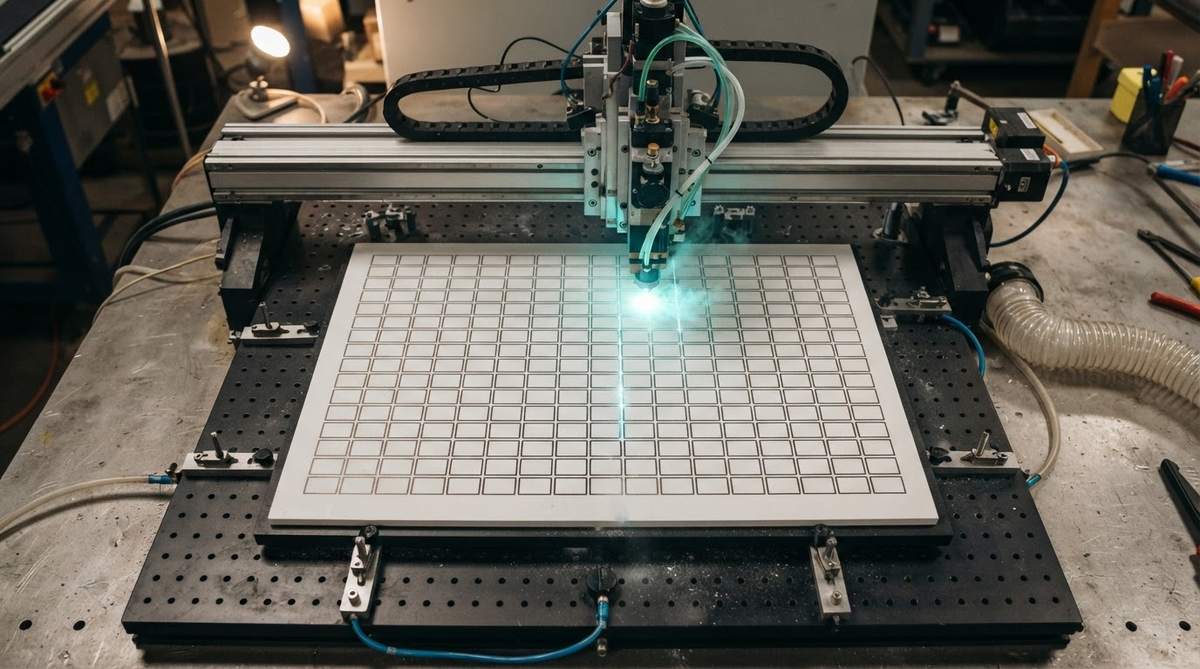
1. Substrate Material
Material choice is the single largest cost lever. Al₂O₃ 96% is the workhorse for most SSR designs. AlN is reserved for SSRs handling very high current densities or operating in environments above 150 °C ambient. Si₃N₄ appears in SSRs subject to severe thermal cycling, such as automotive electronics applications, because of its superior fracture toughness (6–7 MPa·m^0.5 versus 3–4 for alumina).
2. Metallisation Method
Most SSR substrates use direct bond copper (DBC) for its ability to carry thick copper (0.3 mm typical, up to 0.635 mm) and handle high current. Active metal brazing (AMB) is chosen when AlN or Si₃N₄ is the base, adding 20–40% to the metallisation cost versus DBC on alumina. Thin-film or DPC processes are occasionally used for low-current signal-level SSRs but are uncommon for power SSRs.
3. Copper Thickness and Patterning
Thicker copper means more material and longer etching cycles. Moving from 0.3 mm to 0.5 mm copper on a DBC substrate adds roughly 10–20% to the per-piece price. Fine-pitch patterning (traces below 0.3 mm) costs more than simple two- or three-pad layouts typical of SSR die-attach substrates.
4. Panel Utilisation
SSR substrates are small—commonly 20 × 25 mm to 40 × 50 mm. Fitting more pieces per standard ceramic panel (typically 114 × 114 mm or 139 × 190 mm for DBC) reduces per-unit cost significantly. Irregular shapes or large keep-out zones waste panel area and raise price.
5. Volume
Setup charges for DBC (tooling, screen preparation, furnace runs) are amortised across the order. Below 100 pieces, setup dominates. Above 1,000 pieces, material and copper become the main cost components. Exploring ways to reduce ceramic PCB cost is worthwhile before committing to a production order.
Key Factors That Raise or Lower Solid State Relay PCB Cost
To summarise the drivers above, here are the levers you can pull during design to manage your total solid state relay PCB cost:
- Choose 96% alumina over AlN or Si₃N₄ unless thermal analysis proves you need the upgrade—material alone accounts for 30–50% of substrate price.
- Maximise panel utilisation by keeping the outline rectangular and minimising keep-out zones; even 2 mm of wasted border per edge can cost one extra row of parts per panel.
- Use standard copper thickness (0.3 mm) unless current capacity demands more; each step up adds 10–20% to metallisation cost.
- Order in batches of 500+ to amortise tooling; the per-piece price at 500 units is typically 40–55% lower than at 50 units.
- Simplify pad layout—a three-pad DBC pattern costs less to etch than a multi-trace design with fine features.
Worked Cost Example: 40 A SSR Substrate
Consider a 30 × 30 mm DBC substrate on 96% Al₂O₃ (0.635 mm ceramic, 0.3 mm Cu both sides), with a three-pad pattern, ENIG finish, and no vias. This example illustrates how solid state relay PCB cost scales with volume.
| Cost Element | Qty 50 | Qty 500 | Qty 5,000 |
|---|---|---|---|
| Ceramic blank | $4.50 | $2.80 | $1.60 |
| DBC copper bonding | $6.00 | $3.50 | $2.00 |
| Patterning & etch | $3.00 | $1.50 | $0.80 |
| ENIG finish | $1.50 | $0.90 | $0.50 |
| Singulation & QC | $2.00 | $1.00 | $0.50 |
| Total per piece | $17.00 | $9.70 | $5.40 |
Indicative pricing for comparison only. Actual quotes vary by supplier, copper thickness, finish, and current material costs.
At 5,000 units, the ceramic substrate adds roughly $3–4 over an equivalent metal-core PCB (MCPCB). But the ceramic version eliminates a separate thermal interface material (TIM) layer and often the external heatsink, which together can cost $1.50–$4.00 per assembly. The net bill-of-materials difference at volume is small or even favourable for ceramic.
Enter your substrate dimensions, material, and order quantity below to get a ballpark cost estimate for your SSR project.
[pcb_calc type=”pcb-quote”]
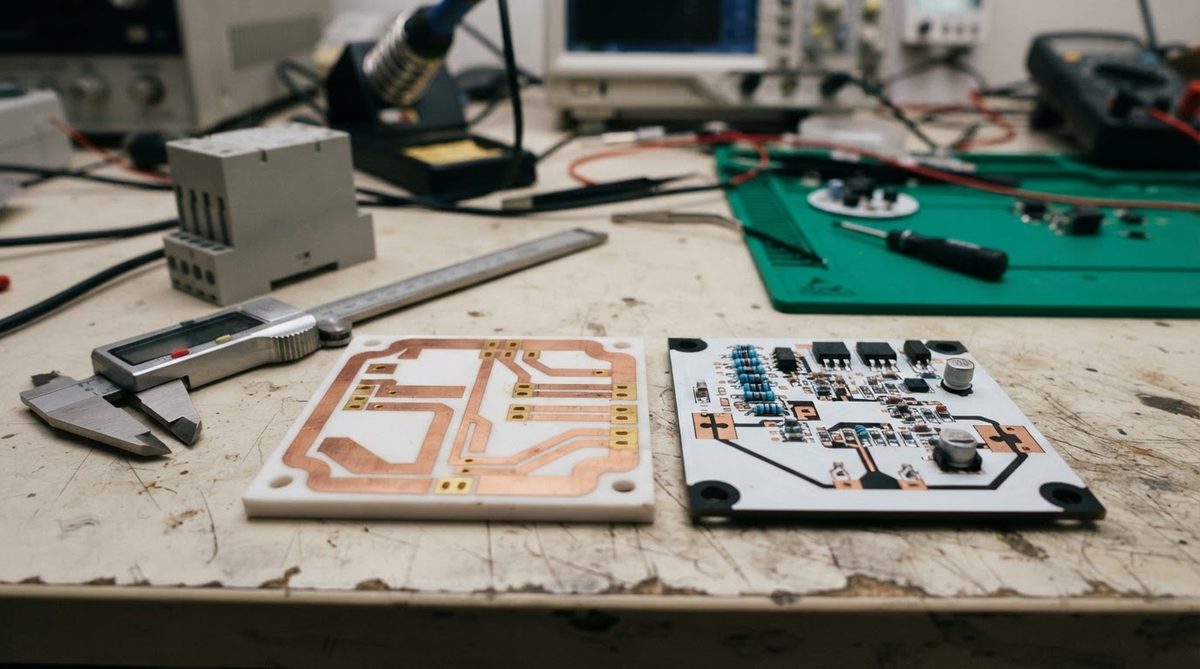
SSR Substrate Material Comparison
| Parameter | Al₂O₃ 96% | AlN | Si₃N₄ | Unit | Condition |
|---|---|---|---|---|---|
| Thermal conductivity | 24–28 | 170–200 | 70–90 | W/mK | 20 °C, per CoorsTek / Kyocera datasheets |
| Dielectric strength | 10–15 | 14–17 | 12–16 | kV/mm | ASTM D149 |
| Flexural strength | 300–380 | 300–350 | 600–800 | MPa | ASTM C1161, 3-pt bend |
| CTE | 7.0–7.5 | 4.5–5.0 | 2.5–3.5 | ppm/°C | 20–300 °C |
| Relative substrate cost | 1× | 3–5× | 4–6× | — | Same footprint, 0.635 mm thick |
Typical values for commercially available material, for comparison only. Confirm against the datasheet for your specific grade.
For most SSRs rated 10–60 A, 96% alumina with DBC copper offers the best cost-to-performance ratio. AlN is justified when thermal resistance must drop below what alumina can achieve—common in IGBT and power module substrates where die sizes are smaller and power densities higher.
When Not to Use a Ceramic PCB for Your SSR
Ceramic is not always the right call. If your SSR operates below 5 A with minimal self-heating, a standard FR-4 board with a copper pour and a clip-on heatsink works fine at a fraction of the solid state relay PCB cost you would pay for ceramic. Metal-core PCBs (MCPCBs) cover a middle ground: better thermal performance than FR-4 (1–3 W/mK effective) at roughly one-third the cost of ceramic, though they cannot match ceramic’s dielectric strength or operating temperature ceiling. For SSRs that never exceed 105 °C junction temperature and do not require high-voltage isolation beyond 1 kV, an MCPCB is usually the more economical choice.
Frequently Asked Questions
How much does a ceramic PCB for an SSR cost at prototype quantities?
Expect $15–$60 per piece for a single 25 × 25 mm DBC alumina substrate at quantities under 50. Setup and tooling charges, typically $200–$500 per design, dominate at low volumes. Reviewing a ceramic PCB cost breakdown can help you plan budget before ordering.
Can I solder semiconductor dies directly to a ceramic SSR substrate?
Yes. DBC and AMB substrates with an ENIG or bare-copper finish accept standard solder die-attach processes (SAC305, AuSn, sintered silver). Surface flatness of the copper pad should be within 25 µm to ensure void-free bonds.
Does switching to AlN always reduce total SSR cost?
No. AlN substrates cost 3–5× more than alumina. They reduce thermal resistance, which can allow a smaller die or eliminate a heatsink, but those savings must outweigh the substrate premium. Run the thermal numbers first; if alumina keeps junction temperature within spec, it is the cheaper path.
What order volume makes ceramic SSR substrates cost-competitive with MCPCB?
At roughly 1,000–2,000 pieces, DBC alumina substrates drop to $5–$10 each for simple layouts, narrowing the gap with MCPCB to $2–$4 per unit. When you subtract the TIM and heatsink that MCPCB assemblies still need, ceramic can break even or pull ahead at these volumes.
Are there hidden costs beyond the bare substrate?
Yes. Account for singulation tooling (laser or scribe-and-break), incoming inspection, and any custom plating. Nickel/gold plating for wire-bond pads adds $0.50–$1.50 per piece depending on pad count and area. Shipping ceramic substrates also requires careful packaging to prevent cracking, which adds modest freight cost.
Next Step
If you have a specific SSR substrate design, upload your Gerber files or drawing for a detailed quote. For a broader look at what drives ceramic board pricing across applications, see the full ceramic PCB cost overview.