ISO 9001, IATF 16949, and AS9100D are the three quality management system (QMS) certifications most commonly required when sourcing ceramic PCBs for automotive, aerospace, medical, and industrial applications. Understanding how ISO 9001 IATF 16949 PCB requirements interact is essential for qualifying suppliers correctly. They share a common backbone — ISO 9001:2015 — but IATF 16949 and AS9100D each add sector-specific requirements that affect traceability, process control, and supplier accountability in ways that matter to your incoming inspection and field reliability.
Key Takeaways
- ISO 9001:2015 is the baseline QMS standard; it applies to any industry and any product, including ceramic PCBs.
- IATF 16949:2016 builds on ISO 9001 and adds automotive-specific requirements such as PPAP, APQP, FMEA, and SPC — mandatory for Tier 1 and Tier 2 automotive suppliers.
- AS9100D adds aerospace and defence requirements including configuration management, risk management at every process step, and first-article inspection per AS9102.
- A supplier certified to IATF 16949 or AS9100D is also, by definition, certified to ISO 9001 — but not the reverse.
- Certification alone does not guarantee product quality; verify scope, audit body accreditation, and certificate validity before qualifying any supplier.
What ISO 9001:2015 Covers for Ceramic PCB Manufacturing

ISO 9001:2015 defines a process-based quality management system. It requires documented procedures for design control, purchasing, production, inspection, corrective action, and management review. For a ceramic PCB manufacturer, this means incoming material inspection of substrates (Al₂O₃, AlN, Si₃N₄), in-process checks during metallisation and etching, and final electrical and dimensional verification.
What ISO 9001 does not require: statistical process control (SPC) on every critical dimension, formal failure mode analysis, production part approval, or lot-level traceability back to raw substrate batch. Those gaps are exactly what the sector-specific standards fill. If your application is industrial power electronics or general LED lighting, ISO 9001 is usually sufficient. If your boards go into a vehicle or an aircraft, it is not.
ISO 9001 IATF 16949 PCB Requirements — What Automotive Adds
IATF 16949 is published by the International Automotive Task Force and is recognised by every major OEM (VW, Toyota, GM, BMW, Stellantis). It incorporates all of ISO 9001:2015 and layers on automotive-specific clauses. The five core tools — APQP, PPAP, FMEA, MSA, and SPC — are mandatory, not optional.
For ceramic PCB procurement, the practical impact is significant:
| Requirement | ISO 9001 | IATF 16949 |
|---|---|---|
| Process FMEA for each product family | Not required | Required |
| Control plan with reaction plan | Not required | Required |
| SPC on critical-to-quality dimensions | Not required | Required (Cpk ≥ 1.33 typical) |
| PPAP submission (Level 3 default) | Not required | Required before first shipment |
| Measurement system analysis (MSA / GR&R) | Not required | Required (%GR&R ≤ 10% acceptable) |
| Lot traceability to raw material batch | Recommended | Required |
| Customer-specific requirements (CSR) | Not addressed | Must be identified and met |
Comparison based on IATF 16949:2016 clauses 8.3–8.7 versus ISO 9001:2015 clauses 8.3–8.7.
If you are sourcing ceramic substrates for an ADAS sensor, an EV power module, or an automotive lidar transmitter, your OEM will almost certainly require ISO 9001 IATF 16949 PCB certification from every link in the supply chain. Ask for the certificate, confirm the scope covers “ceramic printed circuit board manufacturing” (not just “electronic component assembly”), and check the IATF database at iatfglobaloversight.org to verify it is current.
AS9100D — What Aerospace and Defence Adds
AS9100D (the international equivalent is EN 9100 in Europe, JISQ 9100 in Japan) adds requirements driven by the consequences of failure in flight-critical hardware. Key additions over ISO 9001 include:
- Risk management — not just a risk register, but quantified risk assessment at design, process, and supply chain levels.
- Configuration management — every revision of a ceramic PCB design must be controlled, and changes require formal approval before production.
- First Article Inspection (FAI) per AS9102 — a complete dimensional and functional verification of the first production unit, documented in a standardised format (Forms 1, 2, and 3).
- Counterfeit part prevention — documented procedures to prevent counterfeit materials from entering the supply chain.
- On-time delivery tracking — AS9100D requires suppliers to measure and report delivery performance; poor delivery can trigger audit findings.
Ceramic PCBs used in aerospace and defence applications — radar T/R modules, satellite power converters, missile guidance electronics — typically require AS9100D certification plus additional flowdown requirements from the prime contractor. These flowdowns often include NADCAP accreditation for specific processes (e.g., soldering, plating), which is separate from AS9100D itself.
How ISO 9001, IATF 16949, and AS9100D Overlap
Think of it as concentric rings. ISO 9001 is the core. IATF 16949 wraps around it with automotive tools. AS9100D wraps around it with aerospace risk and configuration controls. A supplier certified to both IATF 16949 and AS9100D maintains a single integrated QMS that satisfies all three scopes, but this is uncommon — most ceramic PCB manufacturers hold one sector-specific certification plus the underlying ISO 9001.
All three standards share Annex SL structure (the ISO “high-level structure”), which means clauses 4 through 10 align across all three. This makes auditing and documentation more efficient for suppliers who serve multiple sectors, but it does not reduce the actual requirements. When evaluating an ISO 9001 IATF 16949 PCB supplier, confirm which scopes are active and whether the certificate covers the specific manufacturing processes you need.
What to Verify Before Qualifying a Ceramic PCB Supplier
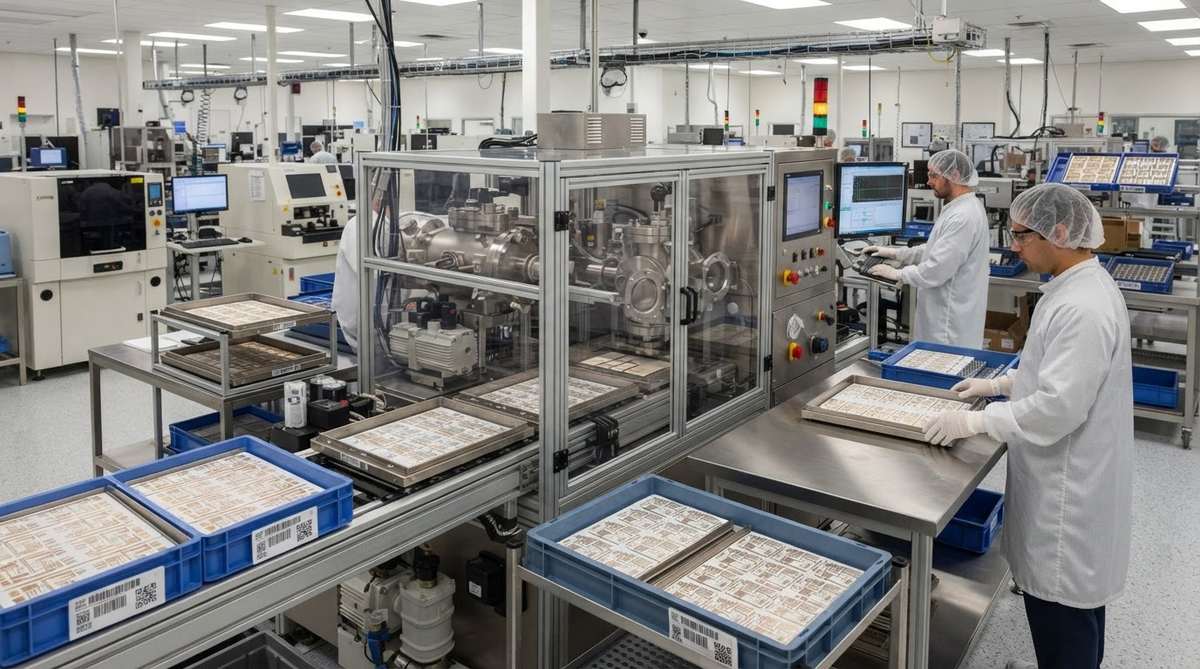
A certificate hanging on a wall — or a logo on a website — is not proof of anything. Here is what to check:
- Certificate scope. Read the scope statement on the certificate itself. It must cover the processes you are buying (e.g., “manufacture of thick-film and thin-film ceramic circuit boards”). A certificate scoped to “trading of electronic components” does not cover manufacturing.
- Accredited certification body. The audit body must be accredited by a recognised national accreditation body (UKAS, ANAB, DAkkS, CNAS). Check the accreditation body’s online registry.
- IATF database listing. For IATF 16949, verify the certificate number at iatfglobaloversight.org. Fraudulent IATF certificates exist.
- OASIS database listing. For AS9100D, verify the certificate at the IAQG OASIS database. This is the only authoritative registry for aerospace QMS certifications.
- Surveillance audit dates. Certificates are valid for three years but require annual surveillance audits. Ask for the most recent surveillance audit report or at minimum confirm the next audit date.
- Applicable IPC standards for ceramic PCB should also be verified — holding ISO 9001 IATF 16949 PCB certification does not automatically mean the supplier tests to IPC-6012 Class 3, for example.
When These Certifications Are Not Enough — or Not Needed
If your ceramic PCBs go into a Class III medical implant, ISO 9001 is necessary but not sufficient. You need ISO 13485, which is a separate QMS standard for medical devices with its own regulatory implications. Neither IATF 16949 nor AS9100D substitutes for ISO 13485.
For prototype or R&D quantities with no regulatory requirement, insisting on IATF 16949 or AS9100D may unnecessarily narrow your supplier pool and increase cost. ISO 9001 plus a clear incoming inspection plan on your end is often the pragmatic choice for development-phase boards.
If your primary concern is material compliance rather than process quality, the relevant documents are RoHS and REACH declarations, not QMS certificates. These are complementary, not interchangeable.
Frequently Asked Questions
Does IATF 16949 certification mean a supplier is also ISO 9001 certified?
Yes. IATF 16949:2016 explicitly incorporates all requirements of ISO 9001:2015. A valid IATF 16949 certificate satisfies any customer requirement for ISO 9001. The supplier does not need a separate ISO 9001 certificate.
Can a ceramic PCB supplier hold both IATF 16949 and AS9100D?
Yes, though it is uncommon. The supplier maintains a single integrated QMS that satisfies both sets of additional requirements. Audits may be conducted by different certification bodies — one IATF-recognised, one aerospace-accredited — which increases audit burden and cost.
How long does it take a manufacturer to get IATF 16949 certified?
Typical timeline from decision to certificate is 12–18 months, assuming the supplier already holds ISO 9001 and has basic quality tools in place. The process includes a gap analysis, system development, at least 12 months of performance data collection, a Stage 1 documentation audit, and a Stage 2 on-site audit.
Is UL listing the same as ISO 9001 certification?
No. UL listing (e.g., UL 796 for printed wiring boards) is a product safety certification — it confirms the product meets specific safety standards. ISO 9001 is a quality management system certification — it confirms the organisation’s processes are controlled. They address different questions and one does not replace the other.
Should I audit my ceramic PCB supplier even if they have current certification?
Yes, for production volumes or safety-critical applications. Third-party certification audits are sampling-based and time-limited. A customer audit focused on your specific product, your critical dimensions, and your failure modes will catch issues that a generic QMS audit may miss. Most automotive and aerospace OEMs require periodic customer audits regardless of ISO 9001 IATF 16949 PCB supplier certification status.
Next Step
If you are evaluating a ceramic PCB supplier for an automotive or aerospace programme, start by requesting a copy of the relevant certificate and verifying it against the IATF or OASIS database. Review our facility and equipment overview to understand which processes are run in-house, then request a quote with your specific quality requirements noted in the RFQ.